

Read the words of Judit Sirhán, teacher, special needs teacher, physical education teacher

In our next – second – blog post, you can read the words of Judit Sirhán, a teacher, special needs teacher and physical education teacher, who tells us about her experiences and lessons learned with the Faster lab.
Dear future Faster Labor Fun-ers!
I’d like to share my thoughts on the impact of Faster Lab, beyond just as a soccer mom, but more as a special education teacher, a special needs teacher, a mother of a child.
When I first took my son with attention deficit disorder and btmn to a session a year and a half ago, I was able to look inside the room and immediately notice the structure of the space, which not only provides an opportunity to learn and effectively apply football skills through smart devices, but also their sensory pathway, which has a number of motor and cognitive developmental effects.
Everyone knows how important hand-eye coordination is in the learning process at school. Equally important is number-foot coordination. If vision does not properly control the movement of the feet, balancing exercises may not always work well, leading to an underdeveloped sense of balance, which can result in impaired attention-concentration skills and directional perception. Developing functional motor skills, coordinating movement and improving body awareness effectively supports neurological organisation. It also helps communication between the brain hemispheres, effectively improving learning outcomes for children with learning difficulties. Here too, movement in the classroom, together with visual, acoustic, verbal emotional stimulation, contributes to the development of the nervous system.
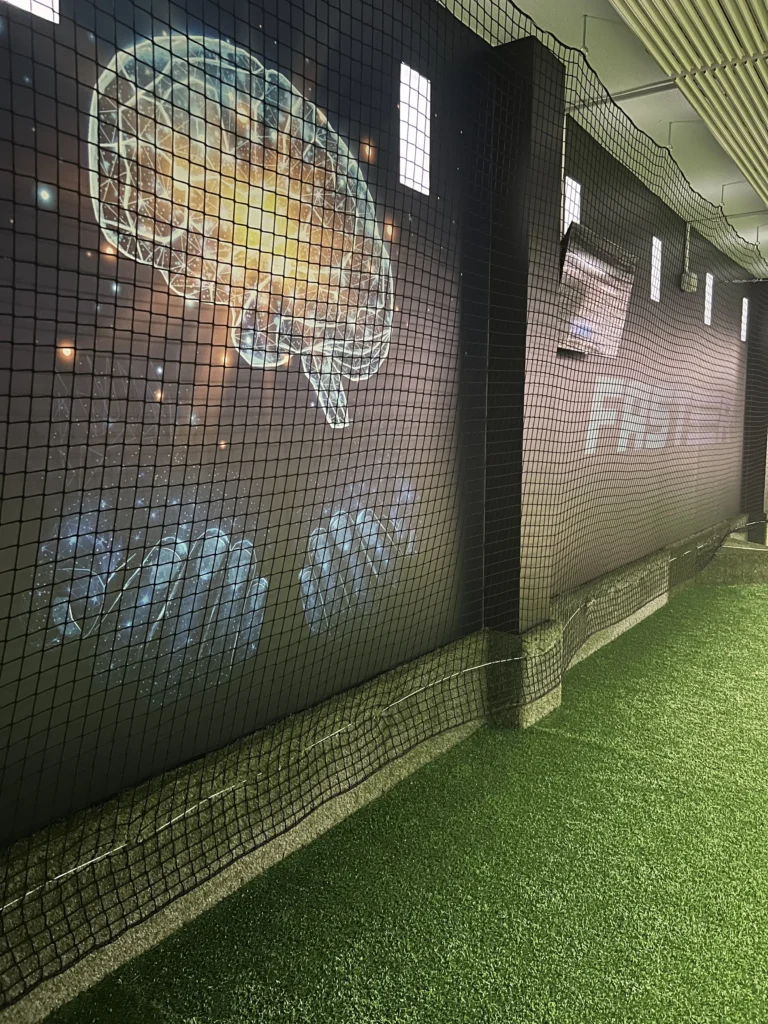
“Here too, movement in the classroom, together with visual, acoustic and verbal emotional stimulation, contributes to the development of the nervous system.”
In addition to learning difficulties, it can also benefit a child’s personality development and social skills. I must admit that for me, the most exciting jobs are TV jobs and the censor’s career. Here, movement sends visual and acoustic stimuli to the brain through cognitive brain training, to which the children respond with small or large movements, and physical and mental development takes place. The tools allow for multiple perspectives of stimulus processing and implementation, increasing the effectiveness of development. Just a few areas of development: -little and large movements -body awareness -dominance -spatial orientation -balance -motor skills -control -acoustic and visual attention -rhythm perception -thinking -cross movements by coordinating the brain hemispheres -decomposition of certain reflex residues -task comprehension -task retention -rule awareness -self-control -motivation Control, evaluation is very important in measuring motivation and the rate of progress, which is also important in setting short- or long-term goals and in the development of a sense of achievement.
For me and for my child, this form of movement is an effective way to develop both at school and on the field.
Judit Sirhán teacher, special education teacher, physical education teacher.

